

Secondary Research
We each went through 2 research articles and recorded key insights from it. We referred to solutions that are currently existing in the AV communication ecosystem.
Findings
· Current Connected Autonomous Vehicles detection rates for pedestrians and cyclists are much lower than for other vehicles.
· Research shows detecting pedestrians from raw sensor data with vision playing a central role is useful in detecting the pedestrians intention of crossing using a skeleton diagram.
· Research shows it is important for pedestrians to know the car is aware of them, the state of the car, and its intentions to increase comfort and trust with AVs.
· Findings suggest that prior exposure to the functionality of the Intent is important in recognition and recall.
· Communication System in autonomous vehicle may be of greater importance than the Intent Communication System itself.
· Lights and Sounds are preferred to written and spoken communication.
· Turquoise is the most salient and discriminable color to utilize in light based AV to Pedestrian communication.
Scenario-based Prototypes
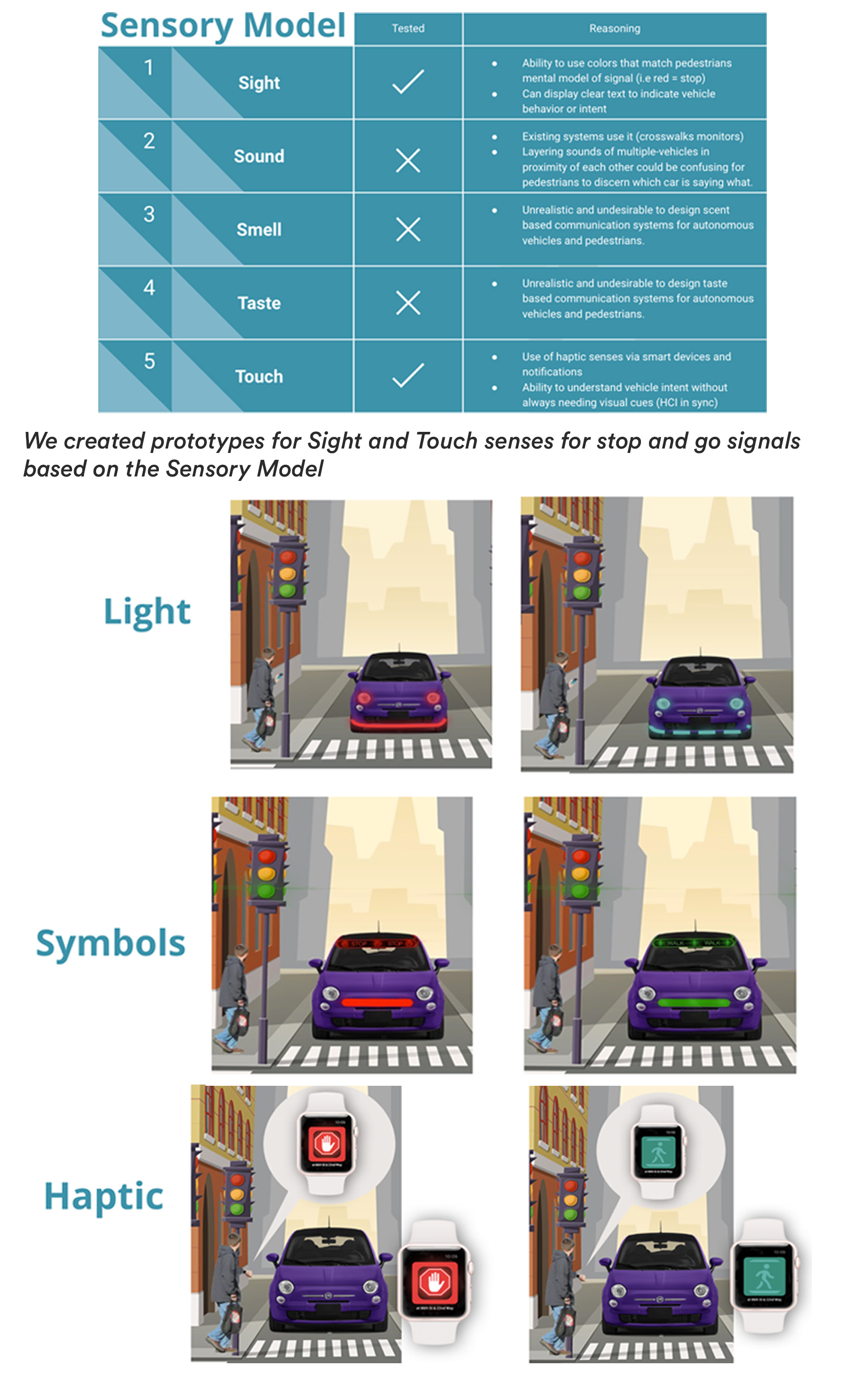
Using the findings from secondary research / literature reviews, we designed scenario-based prototypes based on the touch and sight senses from our "Sensory Model". Group discussion revealed that sound, smell and taste were not relevant for our use cases.
We used these and a combination of these prototypes to conduct testing and interviews during Primary Research.
Primary Research
We started by devising plans for a survey study and semi-structured user interviews.
· They were both designed to measure perception of AVs, likes and dislikes of proposed communication methods, understand how pedestrians interact with vehicles,
and identify opportunities for addressing pedestrian pain points. For the survey, we stuck to quantitative questions.
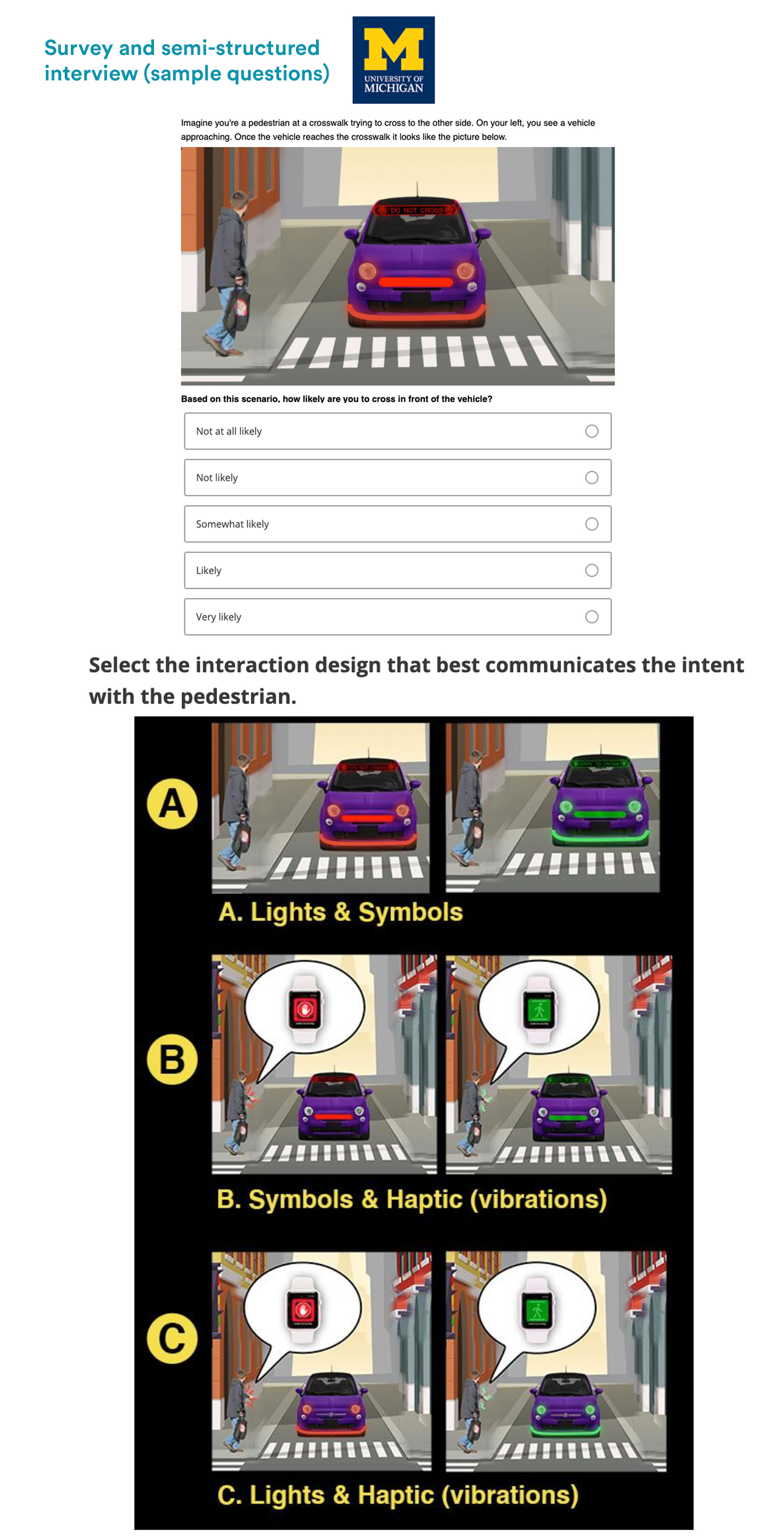
We tested AV interactions with pedestrians through a scenario-based approach. We asked study participants to imagine themselves in different scenarios that have the same framing: "During the day, imagine you are at a crosswalk trying to cross. On your left, you see a vehicle approaching. Once the vehicle reaches the crosswalk you see <Show picture of vehicle communicating intent with the pedestrian> Based on this scenario, we would like to ask you a few questions. "
We had six participants between the ages of 18-61. We showed them images of a pedestrian at an intersection, interacting with a fully autonomous vehicle and studied their expectations and reactions. We used three different methods of communication (light, symbols, and haptic) and asked about insights on each method. We asked them to choose the two methods of communication they felt were most effective. Finally, we presented a combination of the two selected methods and learned their perceptions.
Findings
· Redundancy is good and multimodal and multi-sensory approaches were preferred
· The combination of text/symbols and light was the most effective way for AV to communicate intent
· Haptic signals can go unnoticed. If used, the vibrations should be made distinct from device notifications and the “cross” signal should be different from “do not cross”
· Age influenced the answers - AV perception and trust
· There was terminology ambiguity. The use of the Hand symbol as a stop signal wasn’t clear whether the car was stopping or asking the pedestrian to stop
· The text message on the display needed to be more intuitive. A few suggestions emerged: DON’T WALK, WALK, VEHICLE STOPPING
Survey 2
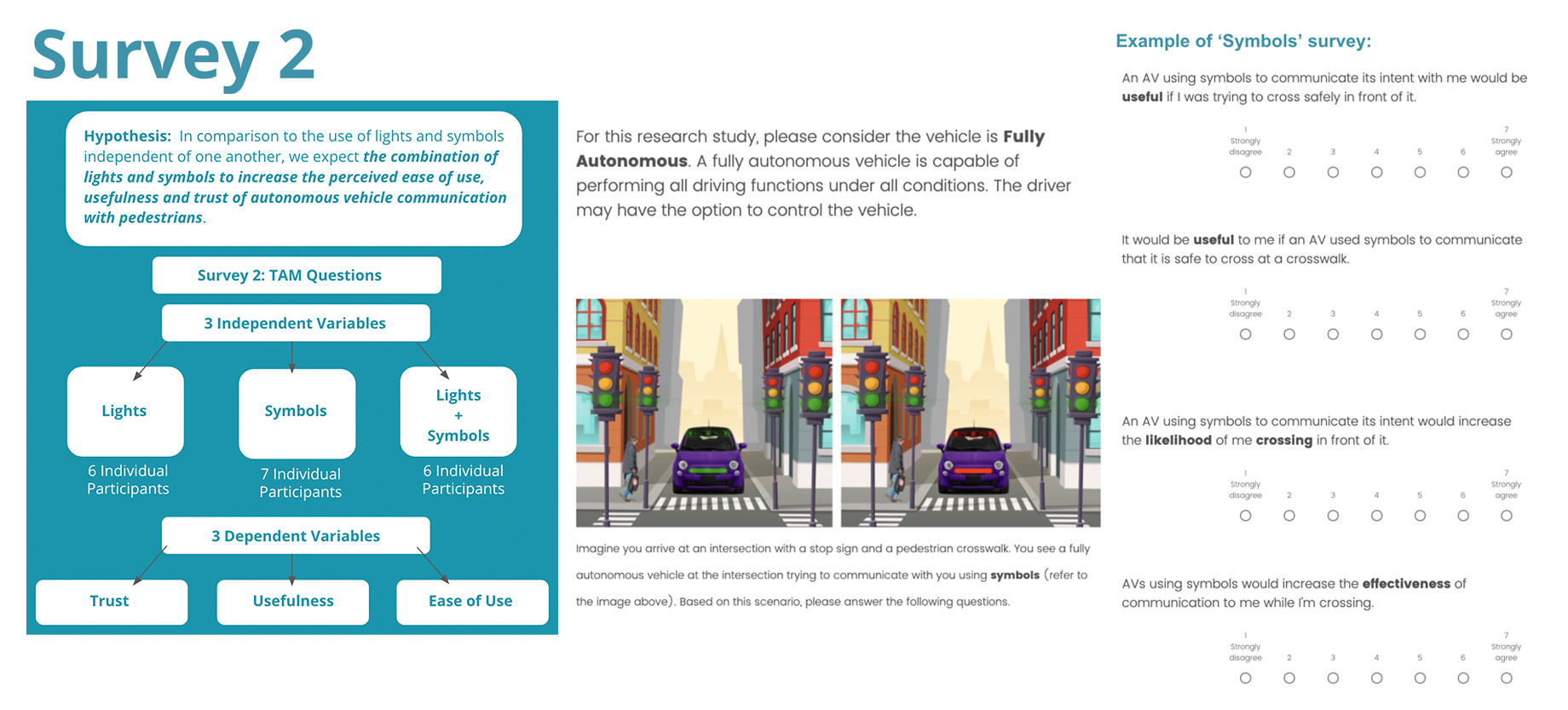
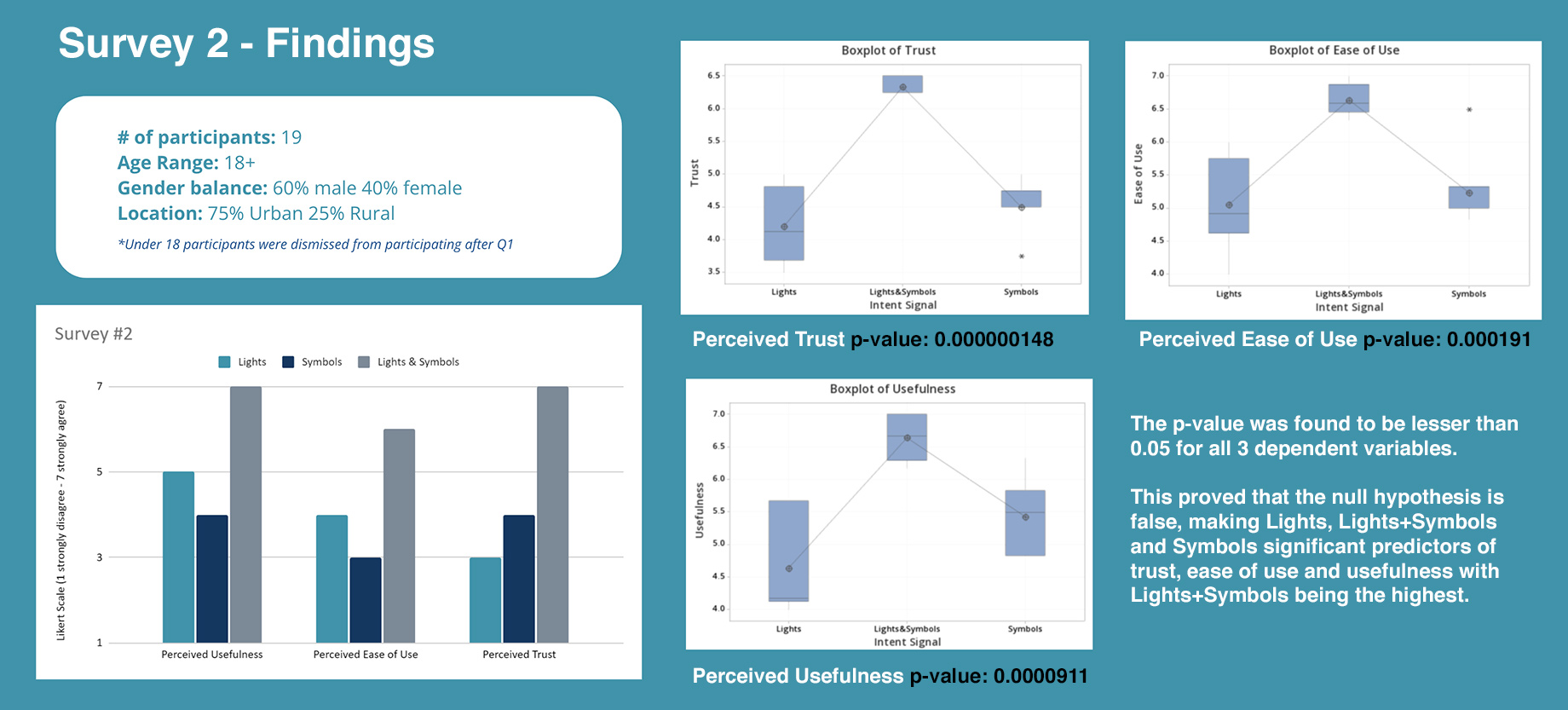
We decided to use the "Technology Acceptance Model (TAM)" to test perceived usefulness, perceived ease of use, and perceived trust. The 3 independent variables were Lights, Symbols and a combination of Lights and Symbols. The 3 dependent variables were Trust, Usefulness and Ease of Use from the TAM.
We had one set of survey questions but three different versions of the survey, one for each mode of communication. The questions were based on the Likert scale from 1-7 with 1 being strongly disagree and 7 being strongly agree. Here are some examples of the questions we asked in our study.
For perceived usefulness we asked, "It would be useful to me if an AV used lights and symbols to communicate it is safe to cross."
For perceived ease of use we asked, "I would find it easy to understand the lights and symbols."
For perceived trust we asked, "I can trust the communication of the intent by the AV."
Survey 2 - Findings
· Although Lights + Symbols had the highest rating for performance between the different modes tested in Survey 1, combining the two improved their usefulness to pedestrians.
· Visual communication methods were preferred more compared to touch/haptic.
· Participants rely on a combination of multi-sensory data from the vehicles, drivers, and existing crosswalk infrastructure to make educated decisions when crossing crosswalks. They expect similar modes of communication between them and AVs.
· From survey data analysis on Minitab, we found the p-value to be less than 0.05. This proves the null hypothesis is false, making the independent variables Lights, Lights+Symbols, and Symbols significant predictors of all 3 dependent variables - perceived trust, perceived usefulness and perceived ease of use, the highest being a combination of Lights and Symbols.
Reflections
There were a few things we could have done differently starting with explaining to participants what an AV is before proceeding with the scenarios. We also found that our participants thought we were removing the existing infrastructure and replacing it with these communication methods. In the future we’d want to explain we are not replacing the existing but adding a new layer of communication to combat what is lost between drivers and pedestrians when the driver is not controlling the vehicle. We also would restructure majority of our research around the Technology Acceptance Model to better test our hypothesis from the start.
If you like what you see and want to collaborate, email me.
askamoolya@gmail.com